Featured Precision Implants & Instrument Sets
Engineered to strict clinical tolerances at our Beijing manufacturing facility. Explore specialized trauma, spine, and arthroplasty systems approved for worldwide medical distribution.
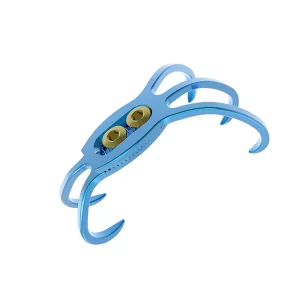
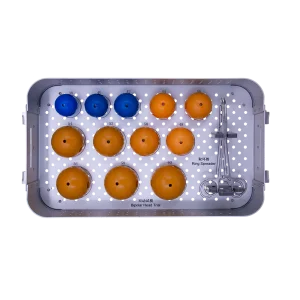
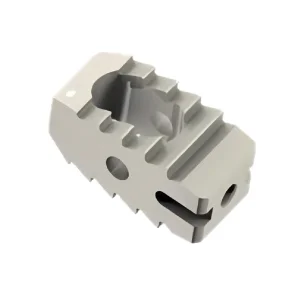
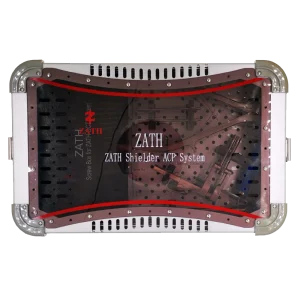
State of Clavicle Osteosynthesis: Biomechanics & Clinical Shift
Evaluating internal fixation biomechanics, anatomical contour morphometry, and next-generation locking plate metallurgy for traumatic midshaft and lateral clavicular disruptions.
Clinical Paradigms in Clavicular Fractures: From Conservative Treatment to Rigid Anatomical Fixation
Historically, fractures of the clavicle—accounting for roughly 2.6% to 4% of all adult fractures and over 35% of shoulder girdle injuries—were predominantly managed conservatively via sling immobilization or figure-of-eight bandages. However, contemporary orthopedic clinical data and multi-center randomized controlled trials (RCTs) have fundamentally shifted this standard. Conservative treatment of displaced midshaft clavicular fractures (Robinson Type 2B, Allman Group I) demonstrated nonunion rates exceeding 15% and symptomatic malunion rates up to 30%, accompanied by significant deficits in shoulder endurance, chronic pain, and brachial plexus impingement due to shortening greater than 15-20 mm.
Today, operative treatment utilizing anatomically pre-contoured locking compression plates (LCP) has emerged as the definitive surgical benchmark. Modern internal fixation demands superior biomechanical torsional stiffness, resistance to cantilever bending loads exerted by the pectoralis major and trapezius musculature, and preservation of periosteal microvascularization. As a premier custom orthopedic clavicle plate manufacturer and exporter, Beijing ZhongAnTaiHua Technology Co., Ltd. (ZATH) designs implant constructs that resolve complex multi-planar stresses while drastically mitigating symptomatic implant prominence beneath the subcutaneous tissue of the pectoral girdle.
Multi-Planar S-Curve Contour
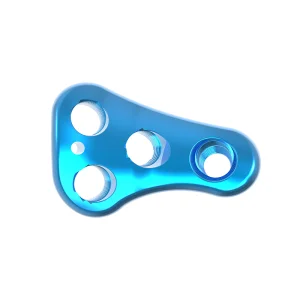
3D-digitized anatomical morphology accurately matches the double-curvature of the human clavicle, eliminating the necessity for intraoperative bending and maintaining inherent fatigue strength of titanium alloy.
Morphometric OptimizationVariable-Angle Locking Matrix
Equipped with combination dynamic compression and threaded locking holes. Provides ±15° polyaxial angulation for convergent bone anchoring in comminuted metaphyseal and lateral osteoporotic bone segments.
Fixed-Angle StabilityUltra-Low Profile Edge Tapering
Engineered with sub-2.5 mm rounded borders and recessed screw heads. Eliminates cutaneous tenting, soft-tissue irritation, and secondary plate removal surgeries common in lean trauma patients.
Soft-Tissue PreservationInternational Procurement Demands: Distributor & Hospital Criteria
Strategic supply chain analysis for orthopedic brand distributors, hospital tender consortiums, and OEM partners demanding verified compliance, margin reliability, and complete instrumentation.
Procurement Bottlenecks in the Modern Orthopedic Trauma Market
Hospital supply chains across Europe, Latin America, Southeast Asia, and the Middle East are experiencing unprecedented margin compression alongside heightened regulatory hurdles. Procurement directors no longer evaluate orthopedic implants purely on unit acquisition costs; rather, they evaluate the Total Cost of Ownership (TCO). Sourcing failures frequently stem from sterile packaging breaches, missing surgical instrumentation sizes, lack of long-term revision implants, or delays in regional product registration files.
To secure tier-one hospital tender bids, medical distributors require an agile, ISO 13485-certified manufacturing partner capable of delivering turn-key trauma solutions. At ZATH, our export infrastructure guarantees full lot-to-lot traceability from raw medical-grade ingot to final double-blister sterile packaging. We provide comprehensive technical files, testing documentation (including ASTM F382 static and dynamic four-point bending fatigue tests), and rapid-response OEM customization of plate profiles, screw dimensions, and customized graphic branding for national distributors.
- MDR & ISO 13485 Compliance: Standardized biocompatibility data (ISO 10993) and comprehensive clinical evaluation reports (CER).
- Sterile-Barrier Packaging: Medical-grade Tyvek blister packaging maintaining validated 5-year sterility according to ISO 11607.
- Matching Ergonomic Tooling: High-precision surgical drill guides, depth gauges, and self-holding screwdrivers in autoclavable modular trays.
- Supply Chain Transparency: Stable raw material sourcing of medical-grade Titanium Alloy (Ti-6Al-4V ELI conforming to ASTM F136).
China Industry 4.0: Precision Engineering & Agile Supply
How Beijing ZhongAnTaiHua Technology Co., Ltd. (ZATH) deploys advanced multi-axis CNC manufacturing, automated optical inspection, and digital supply pipelines at Zhongguancun Science Park.
Multi-Axis CNC Swiss Machining
Utilizing high-end DMG MORI and Citizen multi-axis machining centers. Complex multi-hole clavicle plates and self-tapping titanium locking screws are turned in single-setup operations to ensure zero run-out and micron-level precision.
Micron TolerancesAutomated Surface Passivation
Controlled anodic oxidation (Type II Anodization) produces a biocompatible, ultra-dense TiO2 protective layer. Reduces fretting corrosion between plate-screw junctions and significantly elevates cyclic fatigue life under dynamic physiological loads.
Biocompatible PassivationCleanroom Packaging & Validated Sterilization
Implant manufacturing terminates in certified ISO Class 7 cleanrooms. Devices undergo multi-stage ultrasonic de-greasing, ultrapure water rinsing, and medical blister sealing with ethylene oxide (EtO) or Gamma irradiation validation.
ISO 11607 CleanroomResilience in Mass Customization: The OEM/ODM Clavicle Implant Advantage
ZATH's production facility, located at Building 6, No. 39 Pinghe Street, Xinggu A Area, Zhongguancun Science and Technology Park, Pinggu District, Beijing, integrates localized material science with scalable Industry 4.0 production scheduling. Traditional overseas contract manufacturers struggle with lead times ranging from 16 to 24 weeks. By vertically consolidating bar stock verification, Wire EDM profile extraction, CNC thread milling, automated optical inspection (AOI), laser serialization, and cleanroom packaging within one physical facility, ZATH shortens prototyping cycles down to 10 days and mass OEM container shipments to 3-4 weeks.
This manufacturing agility enables our global partners to deploy bespoke anatomical configurations—such as specialized Asian or Caucasian clavicle curvature lines, anterior-inferior plating systems, or lateral hook extensions with variable angles—without taking on immense inventory carrying costs or facing chronic back-orders during trauma surge periods.
Clinical Application Scenarios: Anatomical Fixation Matrix
Differential plate positioning, biomechanical load-sharing, and surgical strategies across midshaft, lateral/distal, and medial clavicular trauma classifications.
Superior Midshaft Clavicle Plating
Indications: Robinson Type 2A/2B, Allman Group I comminuted shaft fractures.
Placed along the superior tension band of the bone. Offers optimal resistance to downward gravitational and cantilever bending stresses. Low-profile plate design with alternate screw trajectory mitigates neurovascular risk to the subclavian artery and brachial plexus.
Superior Tension BandAnteroinferior Midshaft Plating
Indications: Transverse or short oblique fractures with poor superior soft-tissue envelopes.
Plates positioned along the anterior-inferior cortex provide an exceptional biological advantage: longer bicortical screw trajectories into denser cortical bone directed posterosuperiorly, entirely avoiding the subclavicular neurovascular bundle below.
Neurovascular SafetyDistal Clavicle & Hook Fixation
Indications: Neer Type II, Rockwood Type III-V acromioclavicular (AC) dislocations.
Engineered with an anatomical lateral cluster featuring multi-directional locking holes for divergent distal screw purchase, or a smooth contoured sub-acromial hook design that secures vertical stability while preserving natural rotator cuff biomechanics.
AC Joint ReconstructionSurgical Instrumentation Synergy: Minimizing Operative Morbidity
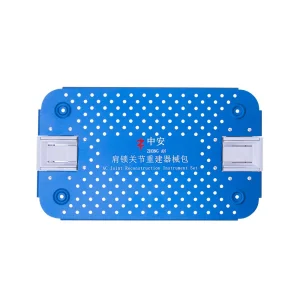
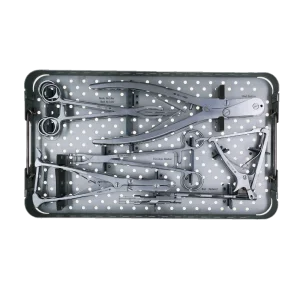
Surgical outcomes do not rely on the implant alone; they are intimately tied to the ergonomic fidelity of the instrumentation set. ZATH provides dedicated clavicle surgical kits featuring custom-radiused reduction forceps, self-centering drill guides, sharp bone taps, and calibrated high-torque hexalobe drivers. The modular trays are fabricated from high-grade anodized aluminum and PPSU polymers, designed for continuous multi-cycle steam autoclaving at 134°C.
By pairing our S-shaped clavicle locking compression plates with quick-coupling guide sleeves, surgeons achieve rapid percutaneous insertion during minimally invasive plate osteosynthesis (MIPO) protocols. This protects the supraclavicular nerve branches, significantly lowers post-operative incisional numbness, and shortens patient return-to-work timeframes.
Titanium Metallurgy & Biomechanical Specifications
Quantitative material metrics, alloy composition standards, and finite element modeling criteria ensuring zero catastrophic in-vivo implant failures.
Ti-6Al-4V ELI (Grade 23)
Manufactured according to ISO 5832-3 and ASTM F136 specifications. Extra-low interstitial content delivers unmatched fracture toughness, dynamic ductility, and corrosion resistance.
Yield Strength > 860 MPaOptimized Elastic Modulus
Structural modulus (~110 GPa) closely parallels cortical bone compared to standard 316L stainless steel (~200 GPa). Substantially reduces stress-shielding and cortical bone porosity.
Physiological Stress SharingASTM F382 Fatigue Compliance
Every plate lot undergoes rigorous four-point bending fatigue cycles (exceeding 1,000,000 cycles at 15 Hz) without evidence of micro-crack initiation or thread-stripping deformities.
1M+ Cycle LongevityScrew Thread Geometry
Variable pitch cortical and locking screws featuring Star/Hexalobe drive heads. Eliminates driver cam-out during dense cortical seating, ensuring predictable insertion torque transfer.
Anti-Cam-Out Torx DriveFrequently Asked Questions: Manufacturing, Regulatory & Sourcing
Authoritative insights directly addressing technical questions from orthopedic distributors, hospital biomedical directors, and overseas procurement agents.
What distinguishes ZATH's S-Shape Clavicle Plates from generic reconstruction locking plates?
Which regulatory certifications and documentation dossiers are provided with export shipments?
Can ZATH accommodate OEM/ODM branding, custom dimensional matrices, and private packaging?
What are the options for sterile vs. non-sterile packaging configurations?
What is the lead time for standard wholesale orders versus custom OEM tooling?
How does ZATH guarantee screw-plate interface integrity and prevent cold welding?
Specialized Traumatology & Reconstruction Instruments
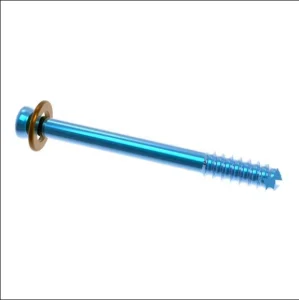
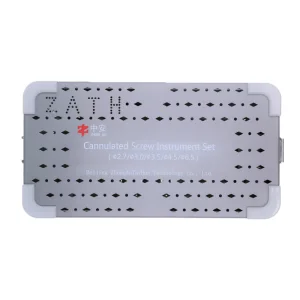
Expanding clinical versatility: Cannulated screw sets, sports medicine reconstruction systems, and fracture fixation instruments engineered under ISO 13485 standards.