Precision Engineered Arthroplasty Sets: Tier-1 Systems
Explore specialized hip reconstructive tooling, trauma compression systems, and high-tolerance surgical instrument sets validated for repeatable surgical efficacy.
Global Market Dynamics & Manufacturing Paradigms
A macroeconomic examination of hip arthroplasty device production, supply-chain localization, and regulatory compliance pressures facing medical device exporters.
Advanced Metallurgical Processing
Modern hip replacement instrumentation demands extreme resistance to cyclical micro-stresses and aggressive autoclaving protocols. State-of-the-art instrument manufacturing employs medical-grade martensitic stainless steels (such as 17-4PH, AISI 420B) and biocompatible titanium alloys (Ti6Al4V ELI).
- Vacuum heat treatments achieve 48-52 HRC edge retention for acetabular reamers.
- Citric and nitric acid passivation pass ASTM A967 benchmarks.
- Zero mechanical seizure between quick-coupling handles and rasps.
Strict Regulatory Traceability
Under the European Union MDR 2017/745 and US FDA 21 CFR 820 frameworks, orthopedic surgical instruments—especially reusable Class I and Class IIa tools—face stringent life-cycle verification. Factory qualification requires exhaustive technical dossiers.
- Laser-annealed Unique Device Identification (UDI) tracking codes.
- Comprehensive autoclave fatigue testing up to 500+ sterilization cycles.
- Bioburden validation and cleanroom residue assessments (ISO 14644-1).
Cost Engineering & Global Sourcing
Global public healthcare systems and volume-based procurement (VBP) policies have accelerated demand for high-precision, direct-from-factory orthopedic instruments that deliver equivalent or superior tactile feedback compared to multinational legacy brands.
- OEM turn-key kit configurations reducing distributor inventory overhead.
- Standardized modular handles compatible across multiple implant lines.
- Streamlined multi-axis machining minimizing batch-to-batch variation.
Emerging Technologies & Next-Gen Instrumentation
How digital surgical planning, robotic-arm registration arrays, and additive manufacturing are transforming modern hip arthroplasty toolkits.
MIS & Direct Anterior Approach (DAA)
Surgical trends strongly favor tissue-sparing approaches like Direct Anterior Approach (DAA) and SuperPath. Instrument kits require specialized curved femoral broach handles, offset acetabular cup impactors, and specialized self-retaining retractors to work inside narrow, muscle-sparing corridors.
Robotic & Optical Navigation Tooling
Smart instrument systems incorporate dynamic tracker arrays, optical reflectors, and calibration pins calibrated directly to surgical robotics. Instrument factories now integrate robotic compatibility testing to ensure impact resistance under robotic-assisted broaching and acetabular milling.
Ergonomic PEEK & Carbon Fiber Hybrids
Weight reduction in large surgical instrument trays is critical for operating room staff ergonomics and autoclave heat dispersion. Advanced exporters are replacing massive stainless steel trials and impactor blocks with medical-grade Radel, PEEK, and carbon-fiber-reinforced composites.
Localized Applications & Clinical Scenarios
Engineered to adapt seamlessly across diverse regional hospital architectures, patient anatomies, and intraoperative challenges.
Primary Total Hip Arthroplasty (THA)
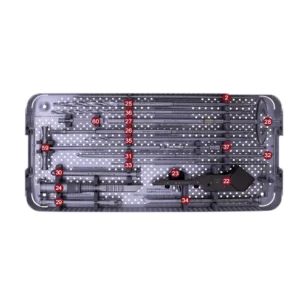
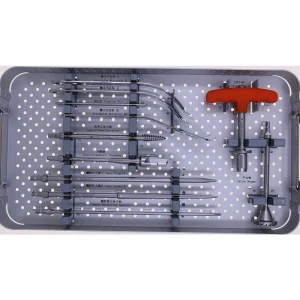
In standard degenerative osteoarthritis or avascular necrosis procedures, our primary THA set provides progressive hemispherical reamers, straight and offset broach handles, modular femoral trial heads, and high-precision cup positioners ensuring optimal anteversion and abduction angles.
Complex Hip Revision Arthroplasty
For loosened prostheses, periprosthetic fractures, or severe acetabular bone loss, revision instrument sets feature heavy-duty stem extractors, flexible curved osteotomes, trephines, broken screw extraction tools, and multi-hole revision shell alignment guides.
Trauma-Induced Hemiarthroplasty
Designed for rapid mobilization in elderly femoral neck fractures. Our bipolar instrumentation delivers rapid calcar planing, precise unipolar/bipolar sizing calipers, and integrated press-fit or cemented stem inserters optimized for operating speed.
Technical Roadmap & Future Outlook
Anticipating next-decade surgical challenges through smart instrumentation, material science, and personalized medicine ecosystems.
Phase 1: Sensor-Integrated Impactors
Real-time telemetry instruments measuring impaction force, seating displacement, and cup tilt during press-fit acetabular insertion. Wireless feedback alerts surgeons to impending fracture or suboptimal bone-implant interface seating.
Phase 2: Patient-Specific Guides (PSI)
Integration of 3D CT reconstruction algorithms into direct 3D printing of single-use, biocompatible polyamide surgical cutting blocks, minimizing instrumentation footprint to custom-tailored procedural kits.
Phase 3: Antimicrobial Nano-Coatings
Application of durable diamond-like carbon (DLC) and silver-nanoparticle vapor coatings on rasp teeth and cutting edges to reduce friction heat, eliminate metallic debris shedding, and inhibit biofilm creation during prolonged procedures.
Integrated Industrial & OEM Ecosystem
A full-spectrum manufacturing infrastructure designed to streamline global supply chains, private-label branding, and international compliance.
Turnkey OEM/ODM Engineering
From 3D CAD modeling and kinematic simulation to rapid prototyping and production, we offer complete private-label manufacturing. We customize laser markings, handle colors, silicone-molded sterilization tray layouts, and localized branding.
Regulatory Dossier Preparation
We provide global distributors with exhaustive technical documentation required for local Ministry of Health registrations, including biocompatibility reports (ISO 10993), sterilization validation (ISO 11137 / ISO 17665), and risk assessments (ISO 14971).
Global Logistics & Buffer Warehousing
To eliminate clinical delivery delays, we operate streamlined export logistics with dedicated forwarders via DHL, FedEx, air cargo, and sea freight. We maintain strategic buffer stock for core replacement components like reamer heads, quick-connect shafts, and trial heads.
Frequently Asked Technical Questions
Key information regarding instrument life cycles, sterilization validation, modular compatibility, and regulatory onboarding.
What specific medical-grade alloys are used in your hip replacement instruments?
We utilize certified surgical-grade alloys tailored to the mechanical demands of each instrument. Cutting instruments (such as acetabular reamers and calcar cutters) are CNC-machined from 17-4PH precipitation-hardened or high-carbon AISI 420B stainless steel for sharp, durable cutting edges. Structural handles and impactors utilize biocompatible Ti6Al4V (Grade 5) titanium alloy or passivated 316L medical stainless steel. All materials are certified with full mill test certificates per ASTM F899 standards.
How are reusability and autoclave cycles validated for your hip instrument sets?
Every reusable instrument family undergoes rigorous sterilization validation in accordance with ISO 17665 (moist heat autoclave) and AAMI TIR12. Testing confirms durability across 500+ standard pre-vacuum steam sterilization cycles (134°C for 4–18 minutes) without dimensional deviation, micro-cracking, joint binding, or corrosion under salt-spray testing per ASTM B117.
Can your factory produce custom broach handles and reamers compatible with other implant systems?
Yes. Our OEM/ODM engineering division routinely manufactures cross-compatible or customized connections, including standard Hudson, Zimmer, Stryker, and AO-type quick-connect couplings. We can engineer custom broach rasp teeth geometries, stem insertion angles, and customized offset angles based on 3D CAD files or reverse engineering with 3D coordinate measuring machines (CMM).
What quality certifications do you provide for hospital tender qualifications?
We supply a complete regulatory packet with all export orders, including our ISO 13485:2016 Medical Device Quality Management System certificate, Free Sale Certificate (FSC), Declaration of Conformity (DoC), material composition certificates, non-pyrogenic cleanliness validations, and autoclave cleaning protocols (IFU) for Central Sterile Services Departments (CSSD).
What is the lead time for custom prototype sets versus bulk production orders?
For custom engineering projects, functional prototypes typically ship within 3 to 4 weeks following final CAD sign-off. Bulk serial production of complete surgical instrument kits (including customized graphic aluminum sterilization cases) normally ranges from 30 to 45 business days, with urgent inventory dispatched via express couriers (DHL, FedEx, UPS) within 4 to 6 business days.
Integrated Orthopedic Surgical Platforms & Instrument Sets
Explore matching instrumentation sets, specialty trauma implants, and advanced joint reconstruction solutions engineered under unified quality standards.