Primary Orthopedic Implants & Instrument Ecosystems
Explore Tier-1 engineered arthroplasty components, cannulated compression systems, and trauma instrumentation ready for international hospital deployment.
Global Commercial & Industrial Landscape of Cortical Screws
Analyzing high-volume osteosynthesis demands, demographic aging vectors, and the engineering transition from standard stainless steels to advanced titanium metallurgy.
The global market for cortical screw implants represents the fundamental backbone of trauma and orthopedic reconstructive surgery. With annual surgical volumes continuously expanding across North America, Europe, the Asia-Pacific, and Latin America, cortical bone screws are universally recognized as the clinical gold standard for securing diaphyseal fractures, stabilizing dynamic compression plates, and anchoring complex multi-fragment reconstructive osteosyntheses. The modern surgical paradigm demands unprecedented dimensional accuracy, dynamic fatigue resistance, and sterile-barrier security to support immediate postoperative load bearing and promote primary bone healing.
Historically dominated by 316L medical stainless steel, enterprise procurement in high-tier clinical networks has undergone a decisive macroeconomic shift toward Ti-6Al-4V ELI (Grade 23, ASTM F136) and Ti-6Al-7Nb (ISO 5832-11) alloys. This migration is fueled by the mechanical necessity to reduce stress-shielding phenomena through an implant modulus of elasticity closer to human cortical bone (approx. 110 GPa vs. 200 GPa for stainless steel), combined with total biological inertness and artifact minimization under magnetic resonance imaging (MRI) and computed tomography (CT) diagnostic monitoring.
Enterprise Procurement Criteria for Global Sourcing Networks
A rigorous evaluation matrix for hospital chains, OEM brand owners, and multinational distributors qualifying high-reliability cortical implant manufacturers.
Certified Metallurgy & Chemical Purity
Implant manufacturing begins with uncompromising raw material provenance. Famous manufacturers enforce strict spectrometer verification of chemical compositions according to ASTM F136 / ISO 5832-3 standards. Strict limits on interstitial elements (Nitrogen ≤ 0.05%, Carbon ≤ 0.08%, Hydrogen ≤ 0.012%, Iron ≤ 0.25%, and Oxygen ≤ 0.13%) guarantee extreme resistance to intra-corporeal corrosion and fatigue failure.
Thread Profile & Torque Mechanics
Cortical screws demand exceptional thread optimization (buttress or modified asymmetrical geometry) maximizing pullout force ($F_{pullout}$) in dense bone. Procurement audits scrutinize torsional yield limits (ASTM F543 Standard Test Method) and screwdriver recess engagement (Hexalobular/Torx versus classic hexagonal drive) to permanently prevent surgical head cam-out or intraoperative shear deformation.
Sterilization & Cleanroom Compliance
Reputable medical device manufacturers operate ISO Class 7 and Class 8 cleanrooms for automated ultrasonic de-burring, multi-stage acid passivation, and sterile barrier packaging. Terminally sterilized units compliant with ISO 11137 (Gamma irradiation or Ethylene Oxide) drastically streamline Operating Room turnaround while ensuring a Sterility Assurance Level (SAL) of 10-6.
Biomechanical Architecture & Technical Roadmaps
Deconstructing the micro-geometry, core-to-outer diameter ratios, and mathematical holding power of modern cortical screw osteosynthesis.
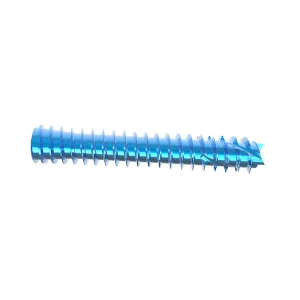
A premier cortical screw is an engineering masterpiece designed to operate in an environment subject to combined axial, bending, and torsional vector stresses. Unlike cancellous screws characterized by deep pitches and coarse threads designed for porous epiphyseal structures, cortical screw implants feature shallow pitch spacing (typically 1.0mm to 1.75mm), a high core-to-outside diameter ratio (approx. 0.65 to 0.72), and razor-sharp self-tapping flutes engineered to evacuate osseous debris during insertion without causing excessive heat necrosis or micro-fracturing of the osteon bundles.
The mathematical pullout capacity of a cortical screw engaged in both the near and far diaphyseal cortices (bicortical fixation) is governed by the shear failure of bone along the cylindrical envelope:
F_pullout = π × d_outer × L_engagement × τ_bone × f_pitch
Where d_outer represents outer thread diameter, L_engagement denotes total cortical wall thickness, τ_bone is the shear strength of host cortical bone, and f_pitch is the pitch-to-depth efficiency coefficient. Modern 5-axis Swiss-type longitudinal turning lathes maintain pitch tolerances within ±0.003mm, ensuring uniform axial load sharing across all engaged threads and preventing the progressive catastrophic micro-motion that causes clinical implant loosening.
Turnkey Industry Solutions for Hospital Networks & OEM Partners
How top-tier Chinese and international manufacturing ecosystems solve supply chain bottlenecks through unified trauma cassettes and private-label agility.
Systemized Modular Instrument Trays
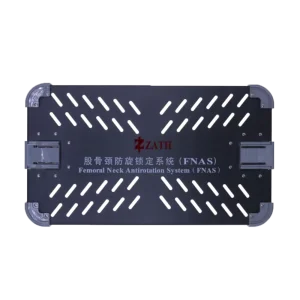
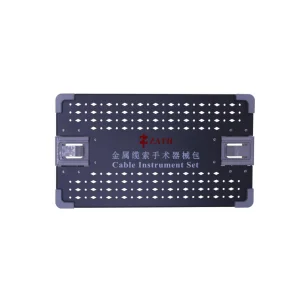
Cortical screws are clinically meaningless without fully compatible instrumentation. World-class manufacturers develop dedicated, steam-autoclavable PPSU and aluminum-alloy containment systems. These include depth gauges with hardened laser-etched scales, color-coded calibrated drill bits, quick-coupling hexalobular screwdrivers with holding sleeves, and drill guides guaranteeing perpendicularity during rapid emergency trauma surgery.
Flexible OEM / ODM Customization
For established multinational device brands and regional surgical suppliers, elite manufacturers provide high-velocity OEM/ODM support. This includes customized screw head configurations (tapered locking vs. spherical dynamic compression), specialized color anodization (Type II and Type III) for immediate OR diameter recognition, laser branding, and tailored sterile blister packaging that conforms to regional regulatory labeling laws.
Buffer Stock & Consignment Reliability
Hospitals cannot wait weeks for fracture fixation shipments. Leading cortical implant companies deploy digital inventory frameworks integrating Vendor-Managed Inventory (VMI) and regional distribution hubs. Express dispatch partnerships (via DHL, FedEx, and air-cargo freight) facilitate sterile stock delivery anywhere in the world within 4 to 6 business days, eliminating surgical postponement risks.
Global Compliance, MDR / FDA Verification & Localization
Demystifying technical dossiers, biocompatibility validations, and regional market registration pathways for international medical tenders.
Navigating global regulatory gateways is the ultimate test of competence for any orthopedic implant manufacturer. Under the stringent European Medical Device Regulation (EU MDR 2017/745), metallic bone screws require comprehensive Class IIb and Class III documentation. This incorporates an exhaustive Clinical Evaluation Report (CER), rigorous Post-Market Clinical Follow-up (PMCF) registries, and comprehensive biological evaluations conforming to ISO 10993-1 for cytotoxicity, systemic toxicity, and genotoxicity.
Furthermore, leading Asian manufacturers who command widespread respect in Europe, the Middle East, South America, and Africa provide turnkey regulatory support packages. These dossiers feature authenticated Free Sale Certificates (FSC), ISO 13485:2016 quality management system accreditations, notified-body audit summaries, and complete biomechanical test certificates detailing static torsion, driving torque, axial pullout resistance, and cyclic fatigue limits according to ASTM F543. By packaging these credentials directly with commercial distribution agreements, local partners achieve shortened registration cycles with ministries of health, reducing time-to-market by up to 60%.
Technology Roadmap: The Future of Cortical Fixation
From bioactive nanostructured surfaces to bioresorbable magnesium architectures and sensor-assisted smart trauma screws.
Surface Nanotexturing & Anti-Microbial Coatings
The next frontier in screw engineering moves beyond mechanical fixation to proactive biological integration. Advanced anodization protocols (electrochemical oxidation forming titania nanotube arrays) enable localized delivery of osteogenic growth factors while preventing bacterial biofilm adhesion (Staphylococcus aureus colonization), drastically mitigating the catastrophic threat of postoperative deep-bone infections.
Absorbable Magnesium & Zinc Alloys
For pediatric trauma and non-load-bearing maxillofacial or extremities reconstructions, bioabsorbable metallic implants are revolutionizing surgical outcomes. High-purity magnesium-rare earth alloys provide immediate rigid cortical holding power that gradually dissolves over 12 to 24 months, metabolizing safely into natural bone tissue and eliminating traumatic second surgeries for implant removal.
Smart Screws & Telemetric Strain Monitoring
Micro-electromechanical sensor integration represents the cutting-edge intersection of AI healthcare and orthopedic hardware. Emerging cortical screws feature micro-piezoelectric sensors capable of transmitting wireless telemetry on intra-cortical strain and micro-motion to clinician smartphones, verifying real-time osteosynthesis healing and accurately identifying non-union before structural mechanical failure occurs.
Enterprise Q&A: Technical & Sourcing Essentials
In-depth responses to the exact questions hospital procurement committees and orthopedic distributors evaluate during supplier qualification.
What is the fundamental mechanical difference between cortical screws and cancellous screws?
Why has the orthopedic industry largely transitioned from stainless steel to titanium cortical screws?
How do self-tapping flutes improve surgical efficiency and reduce thermal necrosis?
What quality management standards are mandatory for international cortical screw export?
Why are Hexalobular (Torx) drive recesses replacing traditional Hexagonal recesses?
Can OEM/ODM cortical screws be manufactured with customized thread diameters and pitch lengths?
What is the clinical value of offering sterile-packed cortical screws compared to bulk non-sterile sets?
What is the standard lead time for international bulk orders and OEM registration samples?
Locking Compression Plates & Specialized Surgical Systems
Explore anatomically pre-contoured titanium plating series, vertebroplasty instruments, and sports medicine repair devices.