
Featured Orthopedic Fixation & Surgical Solutions
Explore precision-engineered orthopedic implants, locking systems, and dedicated surgical sets manufactured under ISO 13485 QMS for distributor portfolios.
Demystifying "Cheap Nails Orthopedic Exporter": Value-Engineered Trauma Metallurgy
In international orthopedic procurement, the search for a "cheap nails orthopedic exporter & company" is rarely a pursuit of substandard craftsmanship. Instead, it reflects an urgent mandate faced by global hospital systems, health ministries, and commercial distributors: how to secure premium-tier titanium and medical stainless steel intramedullary nailing systems that comply strictly with international biomechanical standards while eliminating unjustified tier-one brand markups.
Grade 5 Ti-6Al-4V ELI & Implant-Grade 316LVM
True cost leadership in intramedullary (IM) nail manufacturing stems from high-yield metallurgy, not metallurgical compromise. Intramedullary nails function under extreme cyclic axial, torsional, and bending loads during fracture healing. ZATH utilizes medical-grade titanium alloy (Ti-6Al-4V ELI conforming to ASTM F136 / ISO 5832-3) and vacuum arc remelted stainless steel (316LVM conforming to ASTM F138). These alloys offer exceptional biocompatibility, optimal modulus of elasticity to mitigate stress shielding, and high fatigue endurance limits exceeding 5 million cycles during dynamic four-point bending evaluations (ASTM F1264).
Elimination of Tier-One Marketing Markups
Multinational medical device corporations spend up to 40% of their operational expenditures on global direct sales forces, legacy royalties, and marketing. As an integrated China manufacturer-exporter, ZATH transfers these efficiencies directly to procurement partners, delivering factory-gate unit economies that allow regional importers to compete aggressively in regional hospital tenders while retaining high gross margins.
Global Trauma Trends: Why Intramedullary Nailing Dominates Modern Orthopedics
The worldwide orthopedic trauma fixation sector is witnessing a decisive clinical migration away from extensive open plating toward minimally invasive intramedullary closed-reduction methods.
Demographic Shift & Fragility Fractures
An aging global population in Europe, the Americas, and Asia-Pacific has accelerated the incidence of osteoporotic trochanteric and subtrochanteric hip fractures. Cephalomedullary nails (such as PFNA designs with helical blades or integrated anti-rotation lag screws) offer superior load-sharing characteristics, enabling geriatric patients to bear weight immediately, shortening hospital stays and dramatically decreasing secondary mortality rates.
Suprapatellar Tibial Approaches
Conventional infrapatellar entry approaches frequently generate long-term anterior knee pain. Modern trauma practices have shifted to semi-extended suprapatellar nailing techniques. This paradigm requires precision-contoured expert tibial nails with specialized radiolucent carbon-fiber aiming arms, dedicated cannula sleeves, and multi-planar distal locking vectors to stabilize proximal, diaphyseal, and distal third fractures without malalignment.
DRG Reimbursement & Centralized Tenders
Government-backed healthcare systems (e.g., NHS in the UK, centralized volume-based procurement in Latin America, and Medicare DRGs in the USA) are capping implant reimbursements. Hospitals can no longer absorb $2,500 premium trauma invoices for standard femoral or humeral nails. B2B exporters offering certified, sterile-packed implants at 60-70% lower acquisition expenditure are systematically displacing uncompetitive legacy vendors.
| Evaluation Parameter | Western Multinationals | Generic Non-Regulated Workshops | ZATH (Factory 4.0 China Exporter) |
|---|---|---|---|
| Raw Material Origin | ASTM F136 Ti-6Al-4V ELI | Industrial scrap or mixed-grade rod | ✓ Verified Medical Billets w/ Mill Traceability |
| Machining Repeatability | Swiss 5-Axis CNC (±0.005mm) | Manual/3-Axis Lathes (±0.05mm) | ✓ Citizen & DMG MORI Multi-Axis CNC (±0.005mm) |
| Quality Certification | MDR / FDA 510(k) | None / Dubious documentation | ✓ ISO 13485:2016, Free Sale Certificates (FSC) |
| Sterility Availability | Sterile Peel Pouch (High Markup) | Non-sterile bulk dirty packaging | ✓ Class 100,000 Cleanroom Pre-Sterilized Ready-to-Use |
| Distributor Cost Basis | Very High (Inflated Overhead) | Extremely Low (High Failure Risk) | ✓ Direct Factory True Cost (Maximum Tender Margin) |
China Factory 4.0: The Engineering Engine Behind Cost-Efficient Orthopedics
How automated smart manufacturing, vertical supply integration, and lean logistics converge to produce world-class intramedullary nails at unbeatable export value.
Multi-Axis Swiss CNC High-Precision Turning
Every intramedullary nail involves complex internal cannulation, dynamic Herzog curvature, fluted outer shafts, and threaded proximal interfaces. Operating Citizen Swiss lathes and German DMG MORI 5-axis machining stations allows continuous single-setup processing, eliminating cumulative fixturing errors and slashing cycle times by 45%.
Vertical Supply Clustering in Pinggu, Beijing
Located within Beijing’s Zhongguancun Science and Technology Park, ZATH benefits from complete regional supply cluster density. From medical vacuum-sintering foundries to dedicated surface anodization lines and certified EO/Gamma irradiation sterilization chambers, the entire value chain is synchronized within a 50km radius.
Agile OEM/ODM & Custom Sizing Capability
Whether client markets require specific distal reamer flutes, custom-tapered diameters for smaller pediatric or Asian patient anatomies, or custom private-label laser etching, our in-house R&D engineering hub develops CAD/CAM rapid tooling profiles in under 14 days, offering tailored flexibility impossible with Western conglomerates.
Localized Applications: From Polytrauma ICUs to Day-Surgery Clinics
ZATH intramedullary nails and precision targeting guides are engineered for diverse anatomical fracture patterns and operating room conditions worldwide.
PFNA Cephalomedullary Solutions
Optimized for 31-A1, A2, and A3 pertrochanteric, intertrochanteric, and high subtrochanteric fractures. The integrated anti-rotation helical lag blade compacts cancellous bone rather than removing it, dramatically decreasing lag screw cut-out risk in osteoporotic bone beds. Complete with radiolucent carbon fiber insertion handles for uncompromised C-arm fluoroscopy.
Interlocking Antegrade/Retrograde Femoral Nails
Engineered with an anatomical 1.5m radius of curvature to avoid anterior cortical impingement during insertion. Dynamic-static slotting accommodates secondary dynamization for delayed union. Retrograde distal entry points allow concurrent management of bilateral femur fractures or ipsilateral tibial "floating knee" traumas through a single incision.
Expert Tibial Intramedullary Systems
Featuring Herzog posterior bend (10.5°) at the proximal end to simplify entry canal insertion. Multi-directional distal locking hole configurations (anterior-posterior, medial-lateral, and oblique) establish rigid biomechanical stability in extreme distal 1/3 pilon-adjacent fracture configurations without compromising periosteal blood flow.
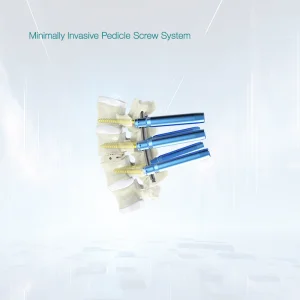
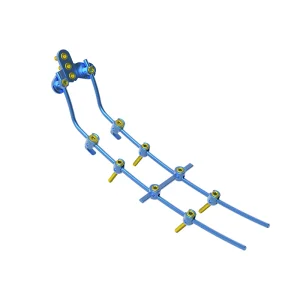
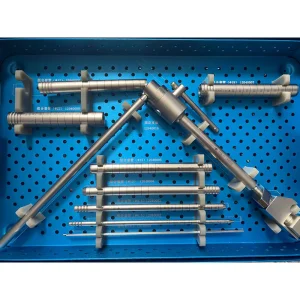
Specialized Joint, Spine & Intramedullary Instrument Families
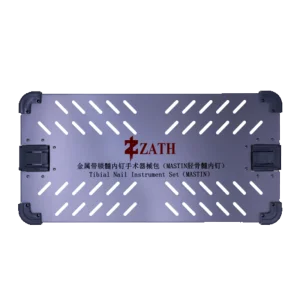
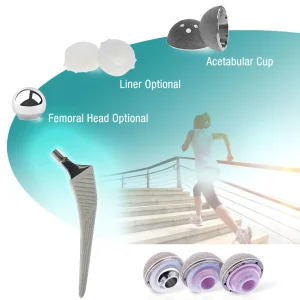
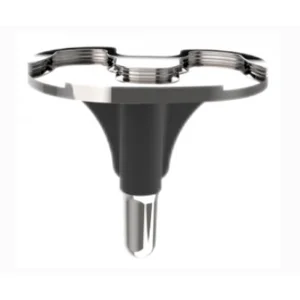
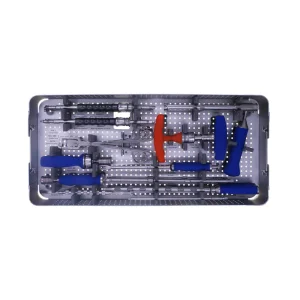
Engineered for extreme reliability: Explore complete trauma nail instrument sets, spinal reconstruction systems, and arthroplasty joint solutions.
Frequently Asked Questions for Orthopedic Exporter Qualification
Direct, transparent answers addressing regulatory readiness, instrument longevity, lot sterilization, and minimum order requirements.