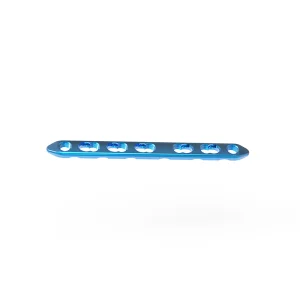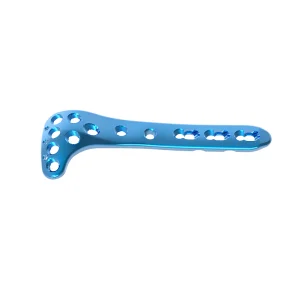
Custom Proximal Lateral Tibia Locking Compression Plate IV
Inquire Specifications
Precision-engineered Locking Compression Plate (LCP) systems, cortical screw arrays, and anatomic trauma implants manufactured under rigorous biocompatibility and micro-mechanical standards for international orthopedic OEM/ODM brands.
Direct supply of medical-grade titanium alloy and PEEK internal fixation solutions machined on 5-axis Swiss-lathe centers with end-to-end lot traceability.
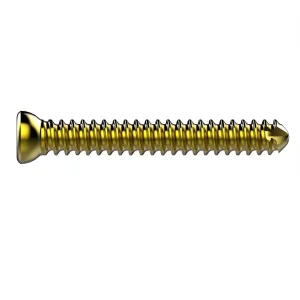
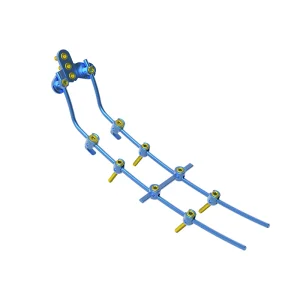
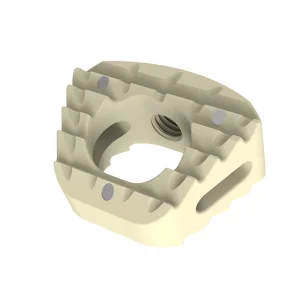
An in-depth whitepaper analysis on clinical demand shifts, market valuations, and the engineering transition from rigid fixation to biological osteosynthesis.
The global orthopedic trauma fixation sector is undergoing a profound structural evolution. Historically, stainless steel dynamic compression plates (DCP) dominated fracture treatment, relying on primary rigid stabilization. However, modern surgical orthodoxy universally favors biological osteosynthesis via Titanium Locking Compression Plate (LCP) systems.
By transforming the plate-and-screw construct into an internal fixator, titanium locking systems eliminate periosteal compression, preserving microvascular blood flow around the fracture callus. This shift has dramatically shortened consolidation timelines and curtailed secondary non-unions, driving steady CAGR expansions worldwide.
Orthopedic surgeons and hospital tenders systematically prioritize medical titanium (ASTM F136 Ti-6Al-4V ELI) over 316L stainless steel due to clear biomechanical and biocompatible differentials:
How state-of-the-art Chinese machining infrastructure delivers medical devices with uncompromised metallurgical integrity and agile cost-to-market performance.
Our Beijing manufacturing park integrates high-end 5-axis DMG MORI, Citizen Swiss-lathes, and Makino milling platforms capable of holding sub-5-micron tolerances on complex, thin-profile multi-axial locking screw holes and anatomical contours.
From Class II Type II hard anodization to electrochemical polishing, our in-line passivation lines guarantee strict adherence to ASTM F86 standards, ensuring zero residual chemical salts, optimal fatigue limits, and uniform visual color coding.
By controlling raw ingot forging verification, precision wire electrical discharge machining (EDM), automatic deburring, cleanroom blister packaging, and gamma/ETO sterilization, we trim ODM development cycle times by up to 55%.
| Evaluation Parameter | ZATH ODM Titanium Plating Spec | Conventional Sourcing Benchmark | Clinical Compliance Standard |
|---|---|---|---|
| Base Metallurgy | Ti-6Al-4V ELI (Grade 23 / ISO 5832-3) | Standard Ti-6Al-4V (Grade 5) | ASTM F136 / ISO 5832-3 |
| Bending Strength (Proof Load) | > 980 MPa Yield Strength | 860–900 MPa | ASTM F382 (Fatigue & Static Bend) |
| Machining Tolerancing | ± 0.005 mm (Thread Pitch & Locking Angle) | ± 0.020 mm | ISO 2768-m Precision Standard |
| Cleanroom Packaging | Class 10,000 (ISO Class 7) Double Tyvek Blister | Non-sterile Bulk Polybag | ISO 11607-1/2 & ISO 11137 / 11135 |
| Traceability Scheme | Laser Annealed GS1 UDI Barcode per Plate | Batch Lot on Secondary Box Only | FDA 21 CFR 830 / EU MDR UDI Annex VI |
Specialized anatomical contours and screw trajectory designs engineered for specific biomechanical loading environments across the human skeleton.
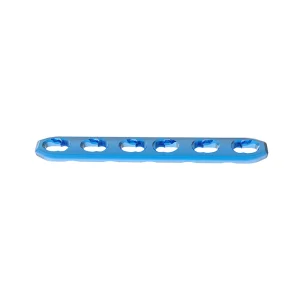
High-energy tibial plateau fractures (Schatzker IV–VI) require pre-contoured proximal lateral plates that conform cleanly to the lateral condyle. Variable-angle locking holes support subchondral screw rafts, providing rigid joint reconstruction and preventing secondary articular collapse under axial loading.
Forearm diaphyseal fractures mandate anatomical reduction to restore pronation-supination kinetics. Limited Contact Locking Compression Plates (LC-LCP) minimize plate-bone footprint, ensuring preserved periosteal blood flow beneath the implant body and reducing stress concentration corners.
In low-density cancellous bone (e.g., proximal humerus, distal femur), conventional cortical screws are prone to toggling and stripping. Fixed-angle locking screws act as a unified mechanical scaffold, redistributing cantilever bending loads across the plate without relying on bone-thread friction.
Strategic R&D domains redefining fracture repair from basic mechanical fixation to smart, bio-inductive osteointegrative implants.
Selective Laser Melting (SLM) is enabling 3D-printed titanium plates featuring porous scaffolds that mimic cancellous bone architecture (60–75% porosity, 300–500 µm pore size), allowing bone ingrowth and reducing the structural modulus below 30 GPa.
Post-surgical surgical site infections (SSI) represent catastrophic clinical failures. Emerging surface modifications incorporate silver-doped hydroxyapatite (Ag-HA) and bioactive titanium dioxide nanotube layers synthesized to eliminate MRSA biofilm adhesion without cytotoxic leaching.
Modern plates feature low-profile, beveled distal tips tailored for subcutaneous tunneling via minimally invasive percutaneous plate osteosynthesis (MIPPO). Combined with radiolucent carbon-fiber targeting guides, surgical exposure and blood loss are curtailed significantly.
A rigorous checklist for medical device distributors, tender authorities, and multinational OEM partners qualifying a Chinese manufacturing facility.
Global distributors cannot compromise on regulatory documentation. A qualified manufacturer must maintain active Technical Documentation Files (TDF) satisfying:
During supplier factory audits, international procurement teams inspect physical infrastructure and control plans:
Direct answers from our orthopedic metallurgical and manufacturing engineering team.
We primarily utilize Ti-6Al-4V ELI (Extra Low Interstitial), conforming strictly to ASTM F136 and ISO 5832-3 standards. For specific anatomical plates requiring intraoperative contouring, commercially pure titanium (CP-Ti Grade 2 or Grade 4, ASTM F67) is optionally available upon OEM request.
We provide comprehensive ODM support: anatomical profile customization from CT DICOM files, locking screw thread pitch alterations, dual-thread variable-angle combi-holes, specialized color anodization (Type II hard anodized gold, blue, magenta), laser branding, custom screw caddies, and dedicated ergonomic surgical instrumentation.
Our plates incorporate precision-machined conical threaded locking holes that engage the matching threaded head of locking screws. This creates a fixed-angle construct that mechanically locks the screw to the plate, converting rotational loosening forces into axial shear resistance.
Yes. All titanium plates and cortical/cancellous screws can be supplied sterile-packed in ISO Class 7 cleanrooms using double PETG medical blisters sealed with DuPont Tyvek lids, validated under ISO 11607 and certified for a 5-year shelf life under gamma or ethylene oxide (ETO) sterilization.
Standard catalog trauma plates maintain ongoing safety buffer stock with fast global shipping (4–6 days via international air express). Custom ODM tooling, DFM analysis, and prototype samples are typically delivered in 3 to 5 weeks, with full-scale production ramped within 45 to 60 days following sample sign-off.
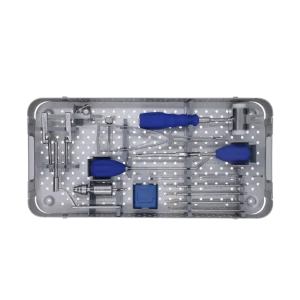
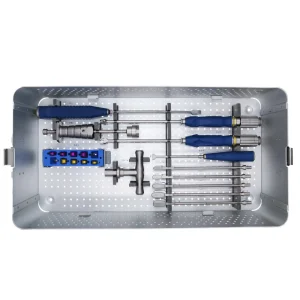
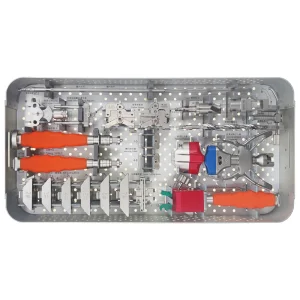
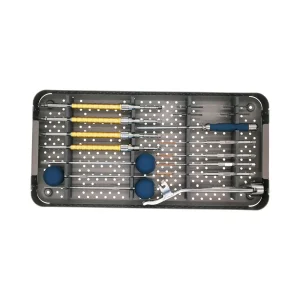
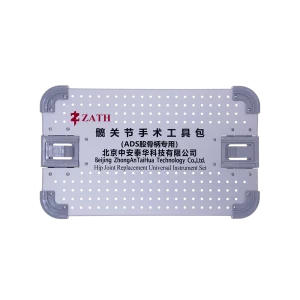
Absolutely. Every bone plating platform is supported by custom autoclavable instrument kits, including torque-limiting screwdrivers, drill bits with quick-coupling ends, threaded drill sleeves, depth gauges, bone reduction forceps, and high-strength aluminum sterilization storage cases.
Explore our extended series of locking compression plates, sports medicine suture anchors, and complete arthroplasty surgical kits.