
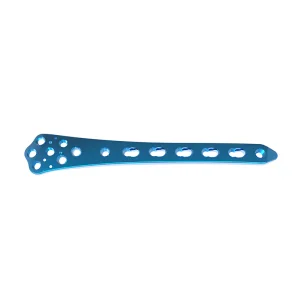
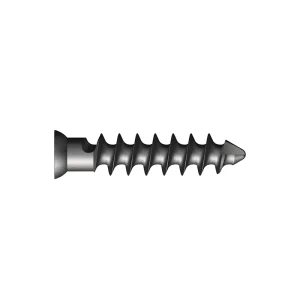
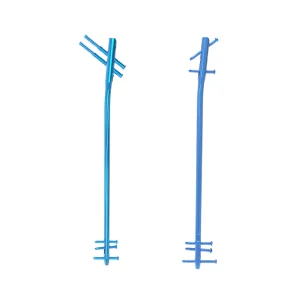
In modern orthopedic trauma surgery, internal fixation using titanium bone plates remains the gold standard for stabilizing complex fractures across the clavicle, humerus, radius, pelvis, femur, and tibia. As international healthcare systems, private surgical groups, and regional medical device distributors seek high-performance solutions without inflated tier-one brand markups, the demand for certified **OEM Titanium Plates for Bone Fracture** has escalated globally.
Navigating the procurement landscape requires evaluating key commercial and technical parameters beyond basic unit costs. Price dynamics are dictated by titanium alloy grades (Grade 5 Ti-6Al-4V ELI versus Pure Titanium Grade 4), anatomical pre-contouring accuracy, surface anodization treatments, 5-axis CNC machining precision, cleanroom packaging, and international regulatory clearance including **ISO 13485:2016, EU MDR 2017/745, and US FDA 510(k)** standards.
Core Procurement Insight: Sourcing titanium plates directly from qualified OEM exporters in China provides global companies with a strategic 35% to 60% unit cost reduction while maintaining exact mechanical performance parity with tier-one Western implant manufacturers.
When procurement managers evaluate quotes for bone fracture plates from international exporters, unit prices can vary significantly—from $25 up to $180 per plate depending on complexity, geometry, and volume tier. Understanding the core cost components prevents hospital buyers from compromising on clinical safety while avoiding unnecessary supply chain markups.
1. Raw Material Metallurgy
Medical-grade Titanium Grade 5 (Ti-6Al-4V ELI per ASTM F136) costs significantly more than industrial titanium or Grade 2 CP titanium. Its superior tensile yield strength (>795 MPa) and fatigue limit are required for load-bearing long bone plates.
2. Multi-Axis CNC Machining
Anatomic locking compression plates (LCP) require 5-axis high-precision CNC milling to shape complex anatomical curves and cut dual-threaded combi-holes (allowing both conventional compression screws and threaded locking screws).
3. Electrochemical Surface Finishing
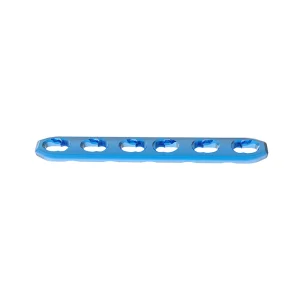
Type II anodization increases fatigue resistance and surface hardness while minimizing cold welding between titanium screws and locking plate holes. Color anodization (pink, blue, gold) assists in OR size identification.
| Implant Category | Material Grade | Typical Hole Range | MOQ (Pcs) | Est. OEM Price (USD) | Target Clinical Application |
|---|---|---|---|---|---|
| Small Fragment Locking Plate | Ti-6Al-4V ELI / CP Grade 4 | 3 to 12 Holes | 50 | $22 - $48 / pc | Clavicle, Radius, Ulna, Fibula fractures |
| Large Fragment Locking Plate | Ti-6Al-4V ELI (ASTM F136) | 4 to 18 Holes | 30 | $45 - $95 / pc | Femoral shaft, Tibial plateau, Proximal humerus |
| Complex Reconstruction Plate | Ti-6Al-4V ELI (High Ductility) | 6 to 24 Holes | 20 | $65 - $140 / pc | Pelvic ring disruption, Acetabular fractures |
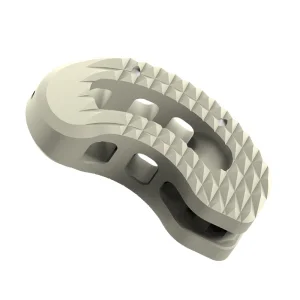
| Cervical & Spinal Anterior Plate | Titanium Alloy (ISO 5832-3) | 1 to 4 Levels | 30 | $35 - $80 / pc | Anterior Cervical Discectomy and Fusion (ACDF) |
| Mini Hand/Foot Locking Plate | Pure Titanium Grade 2 / 4 | 2 to 10 Holes | 100 | $12 - $30 / pc | Metacarpal, Metatarsal, Phalangeal osteotomies |
The biomechanical success of internal osteosynthesis depends heavily on matching the modulus of elasticity between the metallic implant and human cortical bone. Traditional 316L stainless steel has a elastic modulus of ~200 GPa, whereas **Ti-6Al-4V ELI exhibits an elastic modulus of ~110 GPa**—significantly closer to natural bone (~18-30 GPa).
Stress Shielding Reduction
Because titanium is less rigid than stainless steel, it transfers optimal mechanical load to the healing fracture site, promoting faster callus formation and minimizing bone resorption caused by severe stress shielding.
Superior MRI & CT Compatibility
Titanium is non-magnetic (paramagnetic). Post-operative diagnostic MRI and CT scans produce dramatically fewer artifacts when titanium plates are used, allowing radiologists and surgeons to assess healing clearly.
Enhanced Biocompatibility & Osseointegration
The stable titanium dioxide (TiO2) passive oxide layer prevents metal ion release (nickel-free), dramatically reducing soft tissue reaction, infection rates, and immune system rejection in pediatric and adult patients alike.
China has emerged as the global epicenter for medical-grade titanium precision machining. Specialized technological zones—such as the **Zhongguancun Science and Technology Park in Beijing**—house integrated manufacturing complexes capable of managing every step of the trauma device lifecycle under one roof.
End-to-End Vertical Integration
From raw bar stock quality inspection to wire EDM cutting, 5-axis CNC milling, automatic deburring, anodizing, ISO Class 7 cleanroom pouch sealing, and gamma/EO sterilization, eliminating sub-contractor margin stacks.
Rapid Customization (ODM Services)
Distributors can request custom plate contours, customized screw hole spacings, laser-etched brand logos, unique color coding, and regional sterile packaging formats adapted to specific national surgical protocols.
Agile Global Freight & Inventory Hubs
Direct air freight dispatch via DHL, FedEx, UPS, and TNT delivers urgent trauma implant re-orders to international distributors within 4 to 6 business days, preventing surgical stockouts in emergency hospitals.
Medical device import regulations require rigorous validation before any bone fracture plate enters hospital operating rooms. Leading Chinese exporters provide complete regulatory dossiers supporting fast-track registration across North America, the European Union, Latin America, Southeast Asia, and the Middle East.
| Certification Standard | Governing Body / Standard | Key Compliance Requirement | Impact on OEM Importers |
|---|---|---|---|
| ISO 13485:2016 | International Quality Systems | Full QMS coverage from design to sterile dispatch | Mandatory prerequisite for global device distribution |
| EU MDR (2017/745) | European Medicines Agency (Class IIb) | Clinical evaluation reports (CER), GSPR compliance, UDI | Enables CE-mark marketing throughout EU member states |
| US FDA 510(k) | United States FDA | Substantial equivalence demonstration to predicate trauma devices | Required for commercial distribution in North America |
| ISO 10993 Biocompatibility | GLP Accredited Testing Laboratories | Cytotoxicity, sensitization, systemic toxicity testing | Guarantees long-term tissue safety post-implantation |
| ASTM F136 / ISO 5832-3 | Materials Standardization Bodies | Chemical composition & mechanical tensile verification | Ensures raw material lot consistency and zero void defects |
Midshaft & Distal Clavicle Fractures
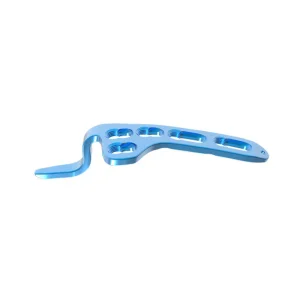
S-shaped pre-contoured clavicle plates fit the complex anatomical S-curve of the human collarbone, reducing intraoperative manual bending, preserving operative time, and minimizing soft tissue irritation.
Complex Pelvic Ring & Acetabular Fractures
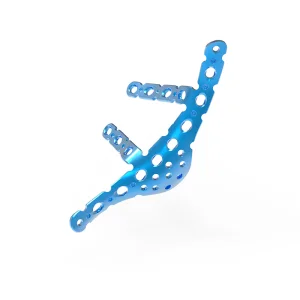
Winged pelvic reconstruction plates provide multi-planar screw trajectory options across the iliac wing and pubic rami, critical for stabilizing high-energy polytrauma injuries resulting from motor vehicle accidents.
Supracondylar & Distal Femoral Fractures
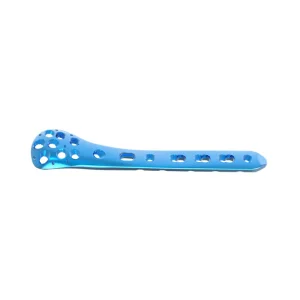
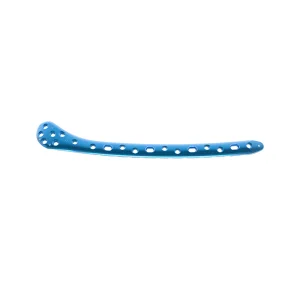
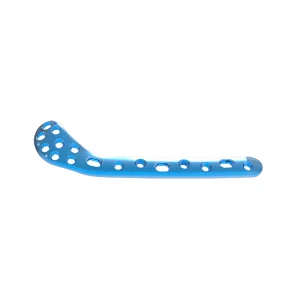
Distal lateral femur locking compression plates (LCP I & ODM systems) feature anatomical distal fan heads with polyaxial or monaxial locking holes designed to hold osteoporotic peri-articular fragments firmly.
The global orthopedic device market is transitioning rapidly toward personalized treatment solutions and less invasive surgical interventions. Key technological advances shaping the next decade of OEM titanium plate production include:
1. Additive Manufacturing (3D Printed Custom Plates)
Direct metal laser sintering (DMLS) allows factories to create patient-specific titanium reconstruction plates directly from CT scan DICOM data, essential for complex maxillofacial and pelvic oncology reconstructions.
2. Micro-Arc Oxidation (MAO) Coatings
Beyond standard Type II anodizing, MAO surface treatments create microporous ceramic oxide coatings infused with antibacterial agents (silver ions) or osteogenic hydroxyapatite, suppressing peri-implant infection rates.
3. Minimally Invasive Plate Osteosynthesis (MIPO)
Plate designs feature tapered ends and low-profile cross-sections, allowing surgeons to slide implants submuscularly through small stab incisions, protecting periosteal blood supply and accelerating bone healing.
What are the standard pricing parameters for OEM titanium bone fracture plates?
OEM titanium bone plate prices typically range from $12 to $140 per piece FOB China, depending on plate size, structural complexity, hole count, material specification (Ti-6Al-4V ELI vs Pure Titanium), surface treatment (Type II Anodization), and order volume. Small fragment plates (e.g. clavicle or radius plates) average $22–$48, whereas complex distal femur or pelvic reconstruction plates average $65–$140 per sterile-packed unit.
What alloy grade is used in ZATH titanium plates, and why is it preferred over stainless steel?
We primarily utilize medical-grade Titanium Alloy Grade 5 (Ti-6Al-4V ELI conforming to ASTM F136 and ISO 5832-3). Titanium provides superior biocompatibility, complete nickel-free allergy safety, reduced stress shielding due to its lower elastic modulus (~110 GPa), and full artifact-free compatibility with MRI and CT diagnostic imaging.
Do you supply matching surgical instrument sets for locking compression plates?
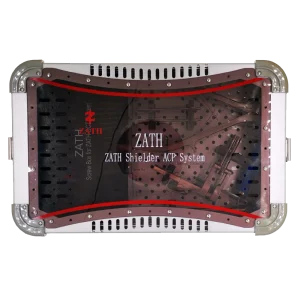
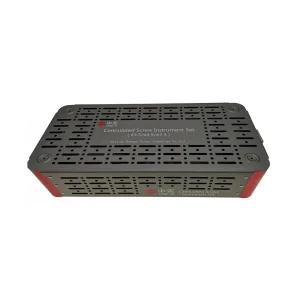
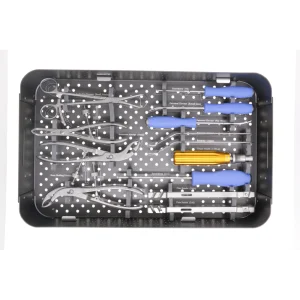
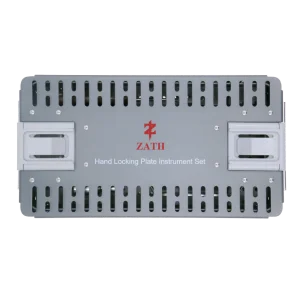
Yes. Every bone plate system (small fragment, large fragment, upper limb, hand, distal femur, spine) is matched with a custom-engineered, stainless-steel surgical instrument set containing color-coded drill bits, drill sleeves, depth gauges, torque-limiting screwdrivers, bending irons, and sterilization holding trays.
What documentation is provided to support national medical device registration?
We supply qualified distributors with complete Technical Documentation Files (TDF), including ISO 13485 quality certificates, Free Sale Certificates (FSC), raw material mill test reports, mechanical fatigue test reports, ISO 10993 biocompatibility test data, and sterile barrier packaging validation reports.
What minimum order quantities (MOQ) apply to custom OEM/ODM orders?
Standard catalog products have an MOQ as low as 20 to 50 pieces per reference. For custom ODM orders involving special plate geometry, custom screw hole threading, or private brand laser marking, MOQs typically range from 100 to 300 pieces per size specification.
How fast can international shipments be delivered to global hospital networks?
In-stock sterile-packed products are dispatched within 48 hours. Urgent air freight orders shipped via DHL, FedEx, UPS, or TNT arrive at most global destinations (Europe, South America, Middle East, Asia-Pacific) within 4 to 6 business days.